



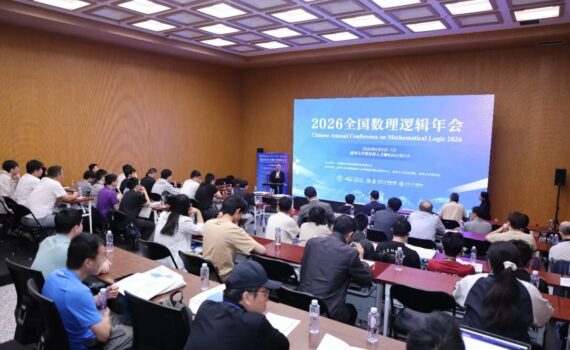


2026 Nov 12 16:00-17:30 Paula Quinon (Warsaw University of Technology) What can we learn about natural numbers from cognitive modelling in conceptual spaces?

2026 Nov 05 14:00-15:30 Zhizhen Ma (清华大学) Does Causal Identification Require Conditional Excluded Middle?——Potential Outcomes and Counterfactuals
Potential Outcomes (PO) is widely used in statistics, social and biomedical sciences to evaluate causal effects. One of the basic assumptions of PO is the counterfactual principle Conditional Excluded Middle (CEM), which expresses the idea that “if A were the case, then B would be the case, or if A were the case, then B would not be the case”. However, CEM is controversial in the counterfactual theory. Hanti Lin developed a stochastic version of PO which drops the assumption of CEM. And he proved that in this new version, the identification theorem (theorem about how to calculate causal quantity from observable quantity) for LATE (a key causal quantity in PO), whose proof relies on CEM in PO, can be retained.
In this talk, I will first give a brief introduction to PO and show how to prove the identification theorem for LATE. Then I will specify the role of CEM in the proof and explain why CEM is controversial. Finally, I will show how to prove the same identification theorem without CEM in Lin’s stochastic setting and discuss some relevant issues.

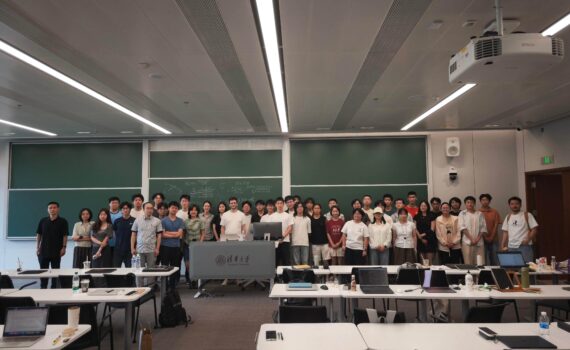
2026 May 7 14:00-15:30 Xin Li (李鑫, Tsinghua University) Blok-Esakia定理
本期进阶读书会将于 2026年5月7日(周四)14:00-15:30 在清华大学逻辑学中心举行,由清华大学李鑫同学报告 F. Wolter, M. Zakharyaschev 的文章 On the Blok-Esakia Theorem,介绍 Blok-Esakia 定理,展示 Blok 提出的代数证明;如有时间,还会介绍该定理在直觉主义模态逻辑中的扩展。More>>

people

education

