
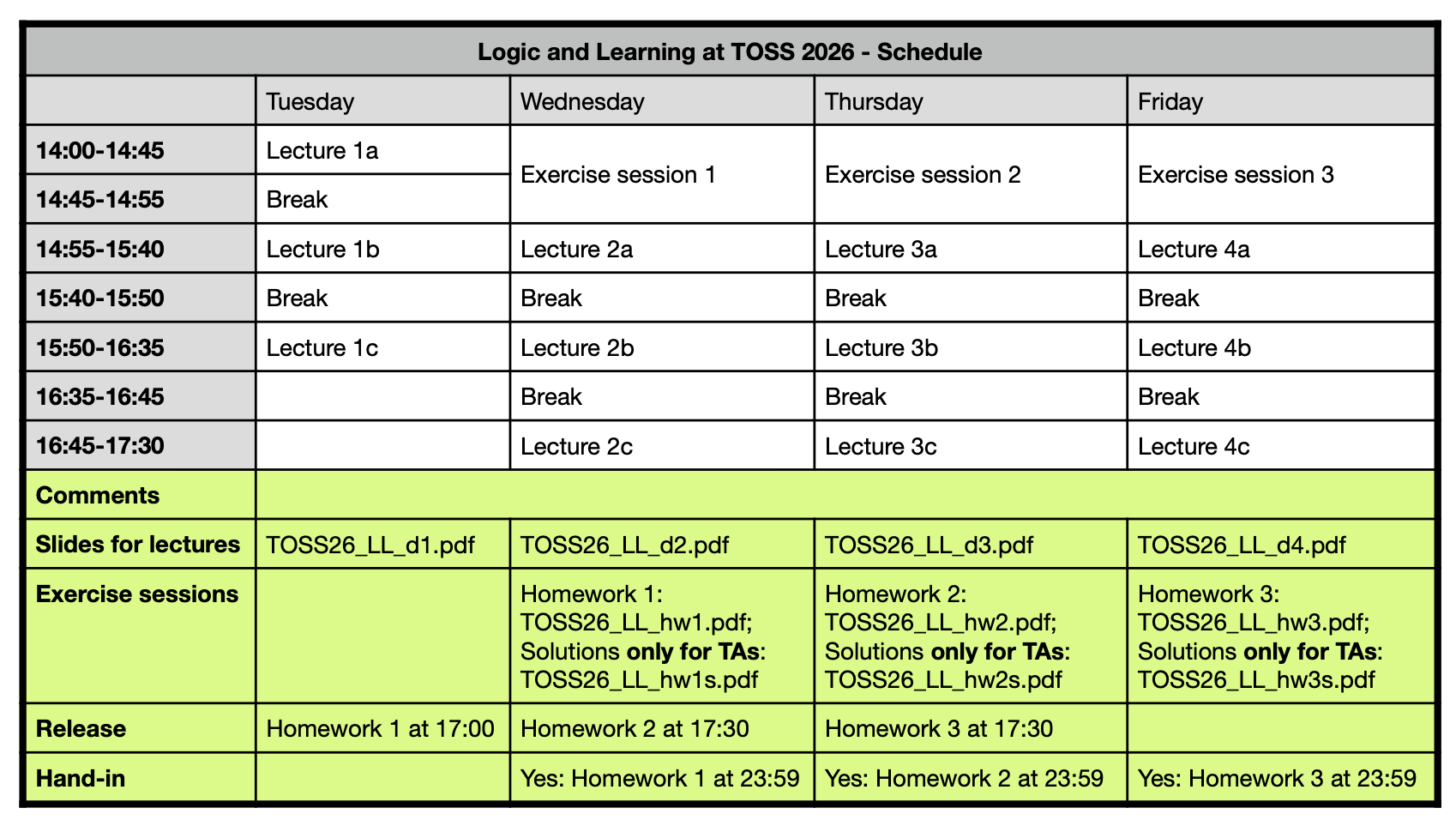
- Dates: June 30th – July 3rd (The exact time is shown below.)
- Location: Jianhua Building A308(建华/经管新楼A308)
- Lecturer: Nina Gierasimczuk (Danish Technical University)
- Teaching Assistants: 欧阳文飞(wenfeiouyang@gmail.com),马郅真(mzz25@mails.tsinghua.edu.cn)
- 本课程对应清华夏季小学期课程“人工智能的逻辑基础”,课程号:00692441-90
- Zoom link: https://dtudk.zoom.us/j/65929338291?pwd=GYJTiPWlavs1iO4esJuzT2bg7qBMkA.1
- Meeting ID: 65929338291
- Passcode: 679846

Course Description
In recent years, modern machine learning systems have shown unprecedented success at learning from data with little human guidance. In parallel to the advancements in AI, Cognitive Science has been very successful at applying a variety of computational models to human learning. Still, computational and cognitive learners are often ‘black-boxes’ lacking interpretation and explanation. How can we reason about, understand, and guide computational learning processes? This course focuses on a particular approach to this problem of describing and reasoning about learning which takes inspiration from Dynamic Epistemic Logic. the lectures will concern both classical problems in learning and recent results about dynamic logics of learning. The course will be interdisciplinary, touching on themes from mathematical logic, theoretical computer science, and formal philosophy, but also cognitive and social science.
Schedule
Background knowledge
The course requires background in propositional logic and basic modal logic (its syntax and Kripke semantics). The necessary background on Belief Revision Theory, Dynamic Epistemic Logic and Learning Theory will be introduced on the first two days. The course will feature technical elements, examples, exercises and discussions.
Assessment
The course will be assessed on the basis of 3 homework assignments and a final written exam.
Course material
- Blackburn, P., de Rijke, M., & Venema, Y. (2001). Modal logic. Cambridge University Press. (Chapter 1)
- van Ditmarsch, H., van der Hoek, W., & Kooi, B. (2007). Dynamic epistemic logic. Springer. (Chapters 1-4)
- Huth, M., & Ryan, M. (2004). Logic in computer science: Modelling and reasoning about systems (2nd ed.). Cambridge University Press. (Chapter 1)
- Hansson, S. O. (2024). Logic of belief revision. In E. N. Zalta & U. Nodelman (Eds.), The Stanford Encyclopedia of Philosophy. Stanford University.
- Johan van Benthem (2007). Dynamic logic for belief revision. Journal of Applied Non-Classical Logics, 17(2), 129–155.
- Baltag, A., Gierasimczuk, N., & Smets, S. (2019). Truth-tracking by belief revision. Studia Logica, 107(5), 917–947.
- E. Baccini, Z. Christoff, N. Gierasimczuk, R. Verbrugge, Who is afraid of minimal revision?, in: Proceedings Twentieth Conference on Theoretical Aspects of Rationality and Knowledge (TARK 2025), volume 437 of Electronic Proceedings in Theoretical Computer Science, 2025, pp. 301–320.
- N. Schwind, K. Inoue, S. Konieczny and P. Marquis, Iterated Belief Change as Learning, Proceedings of the Thirty-Fourth International Joint Conference on Artificial Intelligence (IJCAI-25), pp. 4669-4677.
- Aravanis, T. (2025). Towards machine learning as AGM-style belief change. International Journal of Approximate Reasoning. Advance online publication.
- Pigozzi, G. (2025). Belief merging and judgment aggregation. In E. N. Zalta & U. Nodelman (Eds.), The Stanford Encyclopedia of Philosophy.
- P. Everaere, S. Konieczny, P. Marquis, The epistemic view of belief merging: Can we track the truth?, in: H. Coelho, R. Studer, M. J. Wooldridge (Eds.), ECAI 2010 – 19th European Conference on Artificial Intelligence, Lisbon, Portugal, August 16-20, 2010, Proceedings, volume 215 of Frontiers in Artificial Intelligence and Applications, IOS Press, 2010, pp. 621–626.
- S. D’Alfonso, Belief merging with the aim of truthlikeness, Synthese 193 (2016) 2013–2034.
- J. Singleton, R. Booth, Truth-tracking with non-expert information sources, J. Artif. Intell. Res. 81 (2024) 619–641.
- N. Gierasimczuk, T. Skafte Truth-Tracking by Belief Merge, 24th International Workshop on Nonmonotonic Reasoning, July 17–19, 2026, Lisbon, Portugal, EPTCS 2026. (to appear)